ChatGPT Ads at a Glance
The fast read before you dive into the full guide.
What it is: OpenAI's paid advertising platform, managed through Ads Manager Beta.
How it shows ads: Campaigns can appear inside ChatGPT conversations when the platform determines the ad is relevant to what the user is trying to do.
Objectives: Two campaign objectives at launch: Views and Clicks.
Account structure: Three layers: Campaign, Ad Group, and Ad.
Targeting at launch: United States only for self-serve campaign targeting.
What makes it different: It matches ads to conversational intent, not just search queries or audience profiles.
In This Guide
Need this built for you?
We help businesses move from "we should test this" to a structured, launch-ready ChatGPT Ads setup with the right campaigns, context hints, landing pages, and measurement.
Book a Strategy CallHow ChatGPT Ads Works (And Why It's Different)
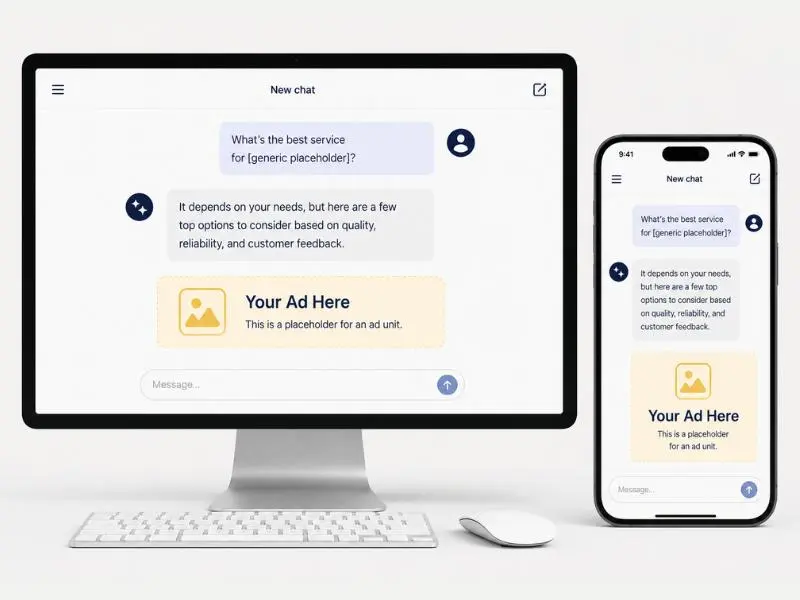
Most advertisers will approach ChatGPT Ads the wrong way at first. They will assume it works like keyword search with a more modern interface. It does not.
ChatGPT Ads is built around conversational context and intent. That means message quality, ad group structure, context hints, landing-page continuity, and measurement discipline all matter immediately. The businesses that understand that early will learn faster and waste less money.
This guide walks through the platform the way a serious operator should think about it: setup, structure, creative, landing pages, tracking, optimization, and the reality of running a beta ad system without pretending it is more mature than it is.
What Is ChatGPT Ads?
ChatGPT Ads runs through OpenAI Ads Manager Beta. That is the platform where advertisers create campaigns, manage account settings, submit ads for review, and monitor delivery and reporting.
At a practical level, ChatGPT Ads gives advertisers a way to appear in relevant conversational contexts when the platform determines that the ad is helpful and aligned to the user's intent. This is a meaningful change from traditional search behavior. Instead of matching against short queries alone, the platform considers the full conversation: what the user is trying to do, what they've already mentioned, and what they need next.
That creates opportunity, but it also raises the standard for advertisers. Weak structure and vague messaging do not have much to hide behind here.
Who Can See ChatGPT Ads? (Eligibility and Availability)
Currently, OpenAI says ads may be shown to logged-in adult users on the Free and Go plans in the United States, Canada, Australia, and New Zealand. OpenAI also says that Plus, Pro, Business, Enterprise, and Education users do not see ads, and users under 18 are excluded.
At the advertiser level, the current self-serve campaign setup documentation says campaigns can target the United States only for now. That is an important distinction. User-side ad availability and advertiser-side targeting are not identical yet.
The takeaway is simple: the platform is real, but still actively expanding. Build with that in mind.
Want Help Turning This Into a Real Launch Plan?
We help businesses move from "we should test this" to a structured, launch-ready ChatGPT Ads setup with the right campaigns, context hints, landing pages, and measurement.
Book a Strategy CallChatGPT Ads vs. Google Ads vs. Meta: What's Different
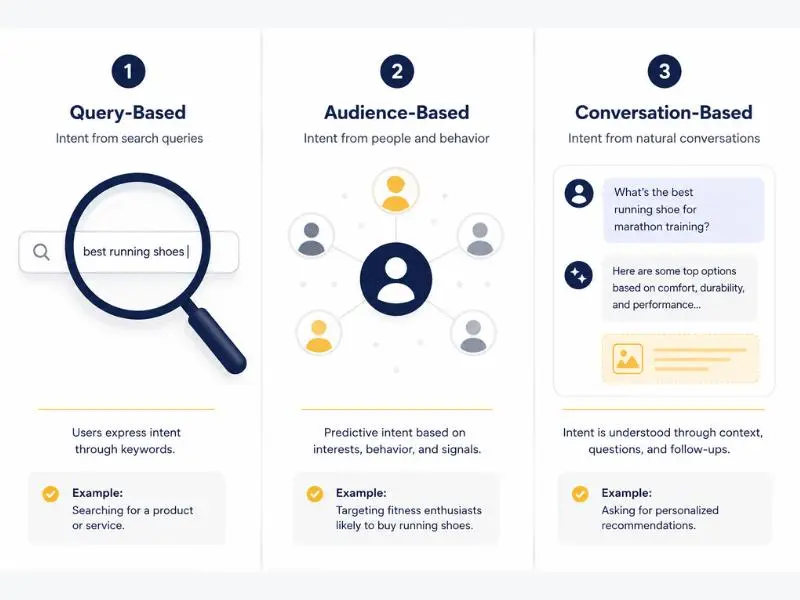
The easiest way to make a mess on ChatGPT Ads is to force old platform habits onto a new environment.
Google Ads is shaped around search queries. Meta is shaped around audience targeting and feed interruption. ChatGPT Ads is different. Here, the platform tries to match ads to richer conversational intent. That means the system is looking at context, not just isolated words.
The implication is important: advertisers need to think in terms of conversation themes, user needs, use cases, and relevant next steps. A good campaign does not just target a market. It gives the platform clear signals about when the offer may actually be helpful.
Should You Run ChatGPT Ads? (Who It's For)
Not every business should rush into a beta ad platform. But many should start preparing now.
If you have a clear offer, a clean landing page, a category that appears eligible, and a team willing to learn, ChatGPT Ads can be a smart early-channel experiment. If your business is still unclear on positioning, your funnel is weak, or your category is likely to face policy restrictions, then the better move may be to fix fundamentals first.
A new platform does not rescue a bad offer. It gives a strong offer a new place to compete.
How to Set Up OpenAI Ads Manager Beta
Before campaigns can run, the account has to be built correctly. That includes onboarding, verification, account information, billing, and access management.
Do not treat this as minor admin work. Your advertiser name and favicon appear in the ad unit. Your billing setup determines whether campaigns can actually serve. Your user access settings determine whether the right people can manage the account once activity begins.
If you manage multiple brands, note that OpenAI currently requires a separate account for each advertiser. That means structure and naming discipline matter from the beginning.
ChatGPT Ads Campaign Objectives: Views vs. Clicks
ChatGPT Ads currently supports two campaign objectives: Views and Clicks.
Views uses CPM pricing and is designed for reach and visibility. Clicks uses CPC pricing and is designed for traffic and engagement. Neither objective is better in the abstract. The right one depends on what you are trying to learn and what kind of action you want the platform to optimize for.
Budget strategy matters here too. One of the most common early mistakes on a new platform is spreading too little budget across too many ideas. If the campaign never gets enough room to deliver, the advertiser learns nothing. A cleaner approach is to prioritize a smaller number of focused campaigns and give them enough budget to produce meaningful signals.
OpenAI's own guidance is clear on this point: budgets should balance prudent testing with enough room to learn.
How to Structure ChatGPT Ads Campaigns
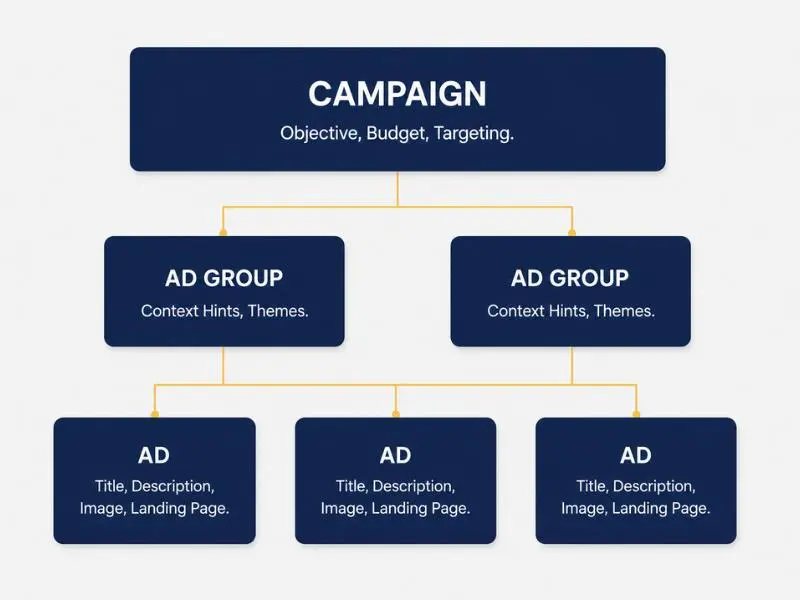
A campaign should represent a real business initiative, not just a random bucket of ads.
That could mean a core service category, a product line, a lead generation offer, a launch, a seasonal promotion, or a specific customer problem. The key is coherence. Campaigns should be easy to understand, easy to name, easy to report on, and clearly tied back to the business objective that justified the spend.
If a campaign tries to do too many unrelated things at once, you do not get efficiency. You get weak signal quality and blurry reporting.
How to Structure Ad Groups and Use Context Hints
This is one of the most important parts of the platform.
Ad groups help organize campaigns into focused themes, use cases, or intent areas. Inside the ad group, context hints help the platform understand the kinds of conversations where your ads may be relevant.
OpenAI is explicit about this: context hints are not exact-match targeting rules. They are signals. That means the advertiser's job is not to cram in keyword fragments. The job is to describe the kinds of questions, needs, comparisons, and situations that define the ad group's intent.
A weak ad group might lump together unrelated needs because they live in the same broad market. A stronger ad group stays tightly focused on one use case, one product category, or one clear intent area.
The cleaner the grouping, the easier it is for the platform to do its job.
Weak context hint thinking
HVAC, air conditioning, repair, emergency AC
Stronger context hint thinking
People trying to solve a broken AC problem quickly, comparing local HVAC options, or looking for same-day repair help during a heat-related issue.
Want This Structured Correctly the First Time?
We help businesses build the campaign map, ad group strategy, context hint framework, and landing-page alignment before launch.
Talk to the ExpertHow to Write ChatGPT Ads That Perform
OpenAI's current ad guidance favors clarity over cleverness. That is a good thing.
In ChatGPT Ads, vague branding language does not help much. The title should make the offer understandable quickly. The description should add useful information, not just repeat the headline with different words. The image should support the message instead of distracting from it.
This is a platform where usefulness is part of performance strategy. Your ads should help a user understand what you offer, who it is for, and why it may be relevant to what they are trying to do.
It is also a good place to test multiple messaging angles. OpenAI specifically encourages multiple variations per offering so the system can match ads across a broader set of conversations. That means your creative strategy should aim for coverage, not just one polished line you personally like.
Landing Pages for ChatGPT Ads: What Works
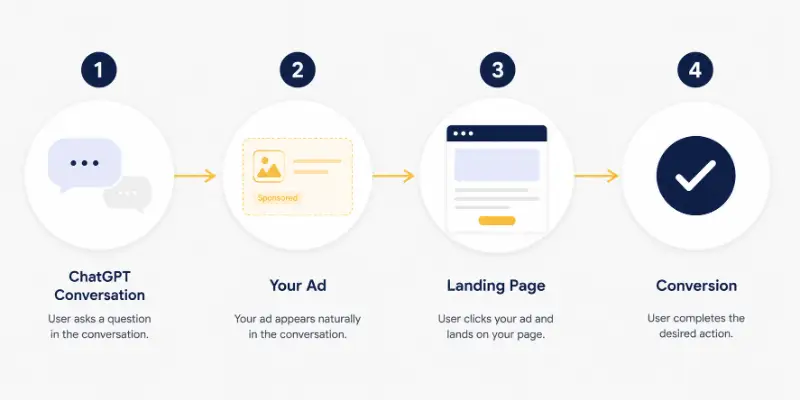
A good ad can still fail if the landing page breaks the flow.
The landing page should continue the promise made in the ad with as little friction as possible. If the ad speaks to a specific need or use case, the destination should immediately confirm that the user is in the right place. The message should be clear, the next action should be obvious, and the page should feel like a logical continuation of the conversation that triggered the click.
OpenAI's guidance also makes two technical points worth taking seriously. First, you can and should add static tracking parameters like UTMs to destination URLs. Second, the landing page must be valid, reachable, and not block OpenAI user agents like OAI-AdsBot and OAI-SearchBot.
Operationally, that means the landing page is not just a design asset. It is part of campaign eligibility, measurement, and performance.
How to Launch and Monitor ChatGPT Ads Campaigns
Once campaigns are submitted, the first job is not aggressive optimization. The first job is making sure the account is actually serving cleanly.
OpenAI says to monitor campaign and ad status in Ads Manager Beta and inspect any Not serving labels for the reason. Common issues include policy conflicts, landing-page problems, billing setup issues, and general approval friction. OpenAI also says there may be a delay of up to seven hours between delivery and reporting, and that advertisers should generally allow up to 24 hours before flagging zero-impression concerns.
That matters because many advertisers confuse not enough patience with bad performance.
ChatGPT Ads Metrics and Reporting: What to Measure
Ads Manager Beta currently reports impressions, clicks, spend, CTR, average CPC, average CPM, and conversions when conversion measurement is enabled.
Those metrics are available in table view, charts, and CSV exports. That gives advertisers enough to judge delivery, pacing, and early engagement, but not enough to support lazy thinking. A Views campaign and a Clicks campaign should not be judged by the same immediate expectations. A campaign testing a new category should not be interpreted the same way as a refined account with a strong landing page and a familiar offer.
Measurement only becomes useful when it is matched to the objective you chose and the learning stage you are in.
Need a Smarter Measurement Plan?
We help businesses connect ad structure, tracking, and landing-page goals so the first round of data is actually usable.
Book a ChatGPT Ads Strategy CallHow to Optimize ChatGPT Ads Campaigns
Early optimization should be controlled, not chaotic.
That means tightening weak themes, improving message alignment, expanding stronger ad variations, refining landing-page continuity, and separating intent areas that should not have been grouped together in the first place.
What it does not mean is changing everything at once because the account made you nervous. Beta platforms already create enough uncertainty on their own. If you constantly rewrite structure, creative, and measurement windows before enough data accumulates, you will not know what is actually helping.
Good optimization is less dramatic than most people think. It is disciplined iteration.
ChatGPT Ads Policy: Allowed and Restricted Categories
This is where many advertisers will get tripped up.
OpenAI's ad policies currently allow only certain categories during the initial rollout, focusing primarily on consumer-friendly verticals such as lifestyle and household goods, local services, travel and experiences, digital products, and education. OpenAI also explicitly disallows or restricts many regulated or sensitive categories, including political content, legal services, healthcare and medicine, many financial services, gambling, adult content, alcohol, and more.
That means category fit is not a side note. It is a gating decision.
Even in otherwise acceptable categories, ads still have to be truthful, non-misleading, professional, and consistent from creative to landing page. No exaggerated claims. No fake urgency. No off-page bait-and-switch. No attempts to imitate the ChatGPT interface in misleading ways.
In other words, this is not a good platform for sloppy advertisers.
ChatGPT Ads Benchmarks: What's Realistic Right Now
OpenAI's own FAQ is direct on this point: there are no established benchmark ranges yet across advertisers, industries, or campaign types.
That is not a weakness. It is just reality.
On a new platform, the first goal is rarely beat an industry benchmark. The first goal is to establish clean delivery, usable signal quality, meaningful traffic, and a repeatable testing framework. If you can do that early, you create the conditions for real scale later.
The advertisers who win first are usually the ones who learn the fastest, not the ones who pretend certainty where none exists yet.
When to Hire a ChatGPT Ads Expert (And When to DIY)
If you have the time, team, and appetite to learn a new platform deeply, you can absolutely build internal knowledge here. But many businesses are better served by shortening the learning curve.
If budget matters, if landing-page quality matters, if the category needs careful judgment, or if the team simply does not want to burn time learning basic platform mistakes, expert help can pay for itself by making the first test more structured and more useful.
The value is not magic. It is cleaner setup, better signal quality, faster diagnosis, and fewer wasted cycles.